Account Information
Adobe Real-Time CDP Features
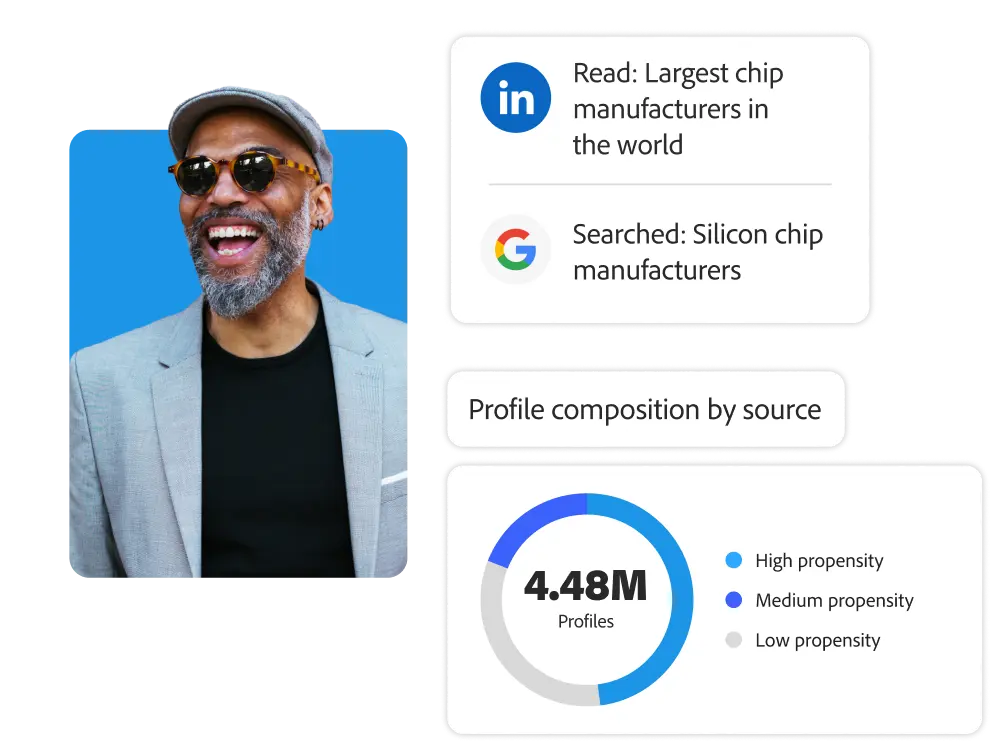
Actionable integrated customer profiles
With a unified single view of your customers, every team member can deliver consistent customer data to your customers
. Help them deliver optimized experiences and increase engagement. Real-Time CDP
allows you to update data from all sources to a unified customer profile and in real time
You can activate it.
. Help them deliver optimized experiences and increase engagement. Real-Time CDP
allows you to update data from all sources to a unified customer profile and in real time
You can activate it.
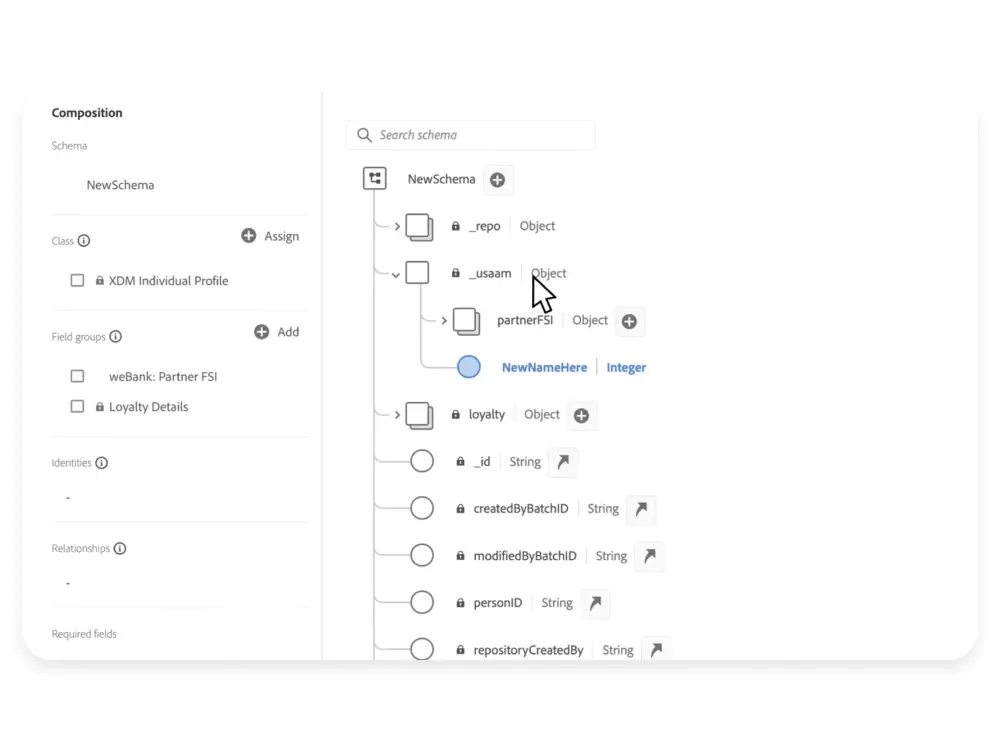
XDM(Experience Data Model)
Standardize how you manage customer data across different teams, systems, and tools using an industry-standard, open-source data model that leverages B2C and B2B data from all channels.
- Open source models. You can use scalable data models across any channel to analyze consumer behavior.
- Interoperability. All business units have a clear view of their data, increasing consistency across applications.
- Pre-built schemas. Use out-of-the-box B2B and B2C data schemas to enhance and customize internal workflows. This allows you to gain insights quickly and meet complex enterprise data needs.
Identity Services
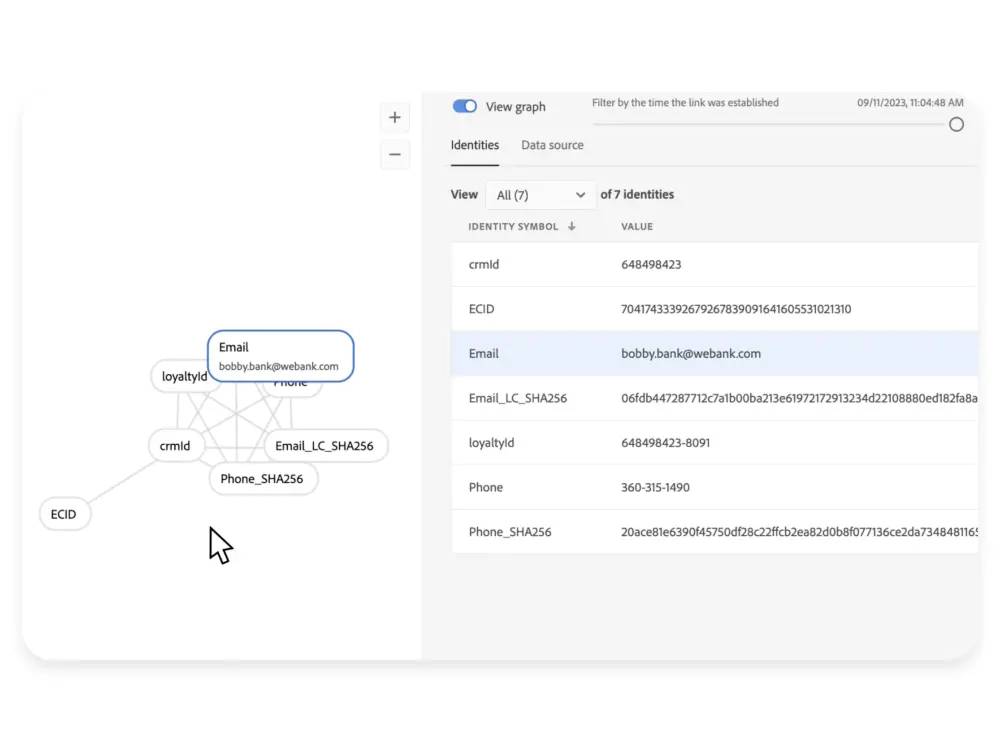
Get a comprehensive view of your customers and their behavior across multiple devices and systems.
- Identity collection. You can collect identity data, including standard IDs, standard and custom namespaces.
- You can use deterministic algorithms to match devices and sign-ins across customer activities.
- Visualization and validation. You can map relationships between identities in the graphical user interface and validate identity associations.
Real-time customer profiles
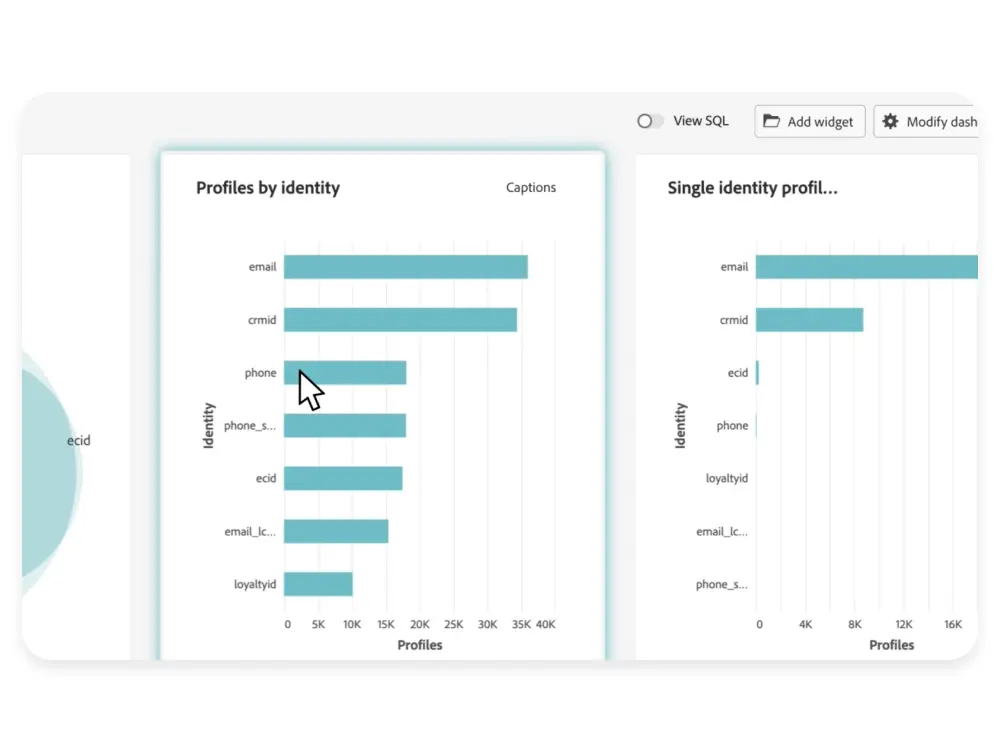
Consolidate data from online and offline sources into a single customer profile for a consistent customer view Build profile snapshots, metrics, and detailed views to validate profile data.
- B2C, B2B, and hybrid profiles. Connect B2C customer data and B2B account data in a single, unified profile across different audiences and business units.
- Real-time updates. You can instantly update your profile at the moment when a customer interacts with your brand.
- Validation and dashboards. Validate and understand profile data with profile snapshots, metrics, and detailed views.
- Unique data. Separate customer and prospect profiles to flexibly support different marketing efforts.
Data integration
Integrate customer data with pre-built connectors, APIs, and SDKs for quick access to all data.
- Live streaming, batch ingestion. Stream data between Adobe and third-party client-side and server-side devices in real time. This allows you to gain insights quickly, accelerate time to market, and engage customers at the right time.
- Pre-built connections. Choose from dozens of data sources and target connectors in the catalog, or easily customize data ingestion and activation configurations to suit your data management needs.
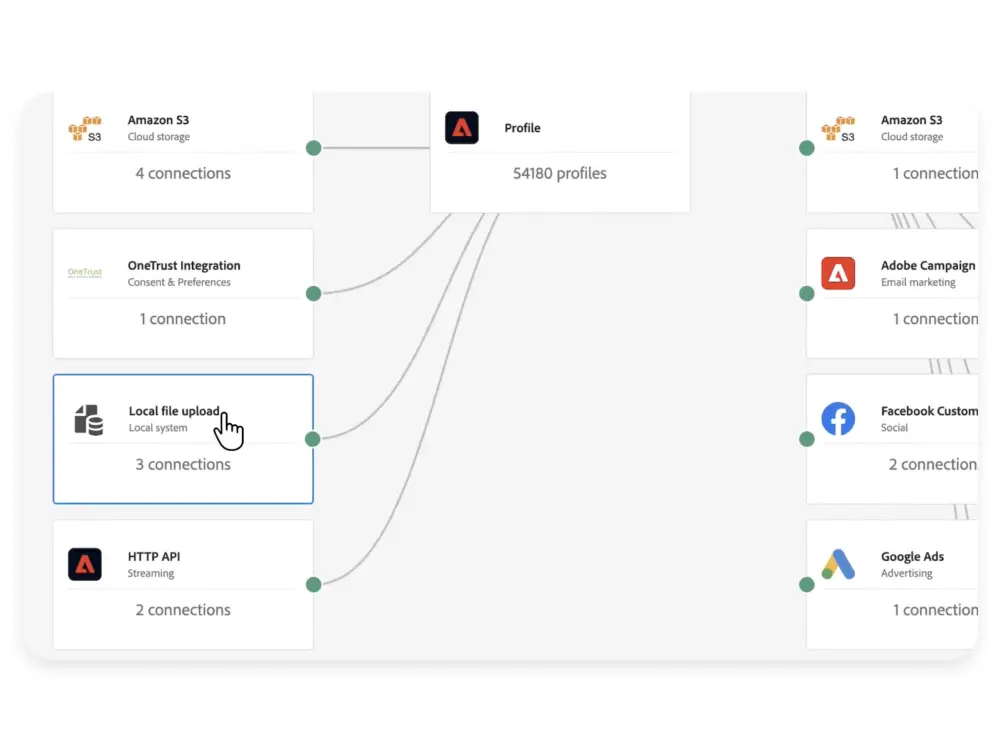
Learn how to use the practical integrated profile features
Adobe Real-Time CDP integrates customer data in real-time to deliver personalized experiences across B2B and B2C environments
. With AI-powered insights, unified customer configuration, and use case playbooks,
marketers can build a complete customer base and conduct efficient targeting campaigns.
Experience League offers a wide range of learning content, including documentation, tutorials, and user guides.
. With AI-powered insights, unified customer configuration, and use case playbooks,
marketers can build a complete customer base and conduct efficient targeting campaigns.
Experience League offers a wide range of learning content, including documentation, tutorials, and user guides.
Let me answer any questions you may have.
What is a unified customer profile?
A unified customer profile is a single view of all the information about each customer. It is created by combining data from various sources, such as CRMs, websites, and apps, into a single record. This allows you to understand customer behavior and attributes.
What are the 4 types of customer profiling?
1. Demographic profiling.
Demographic profiling is usually the first step in understanding your customer base. It includes basic statistical categories such as age, gender, income, education level, occupation, marital status.
This type of profiling is a good starting point. However, there is a limitation that you can only grasp a part of the total information. Just because two customers are of the same age or income level doesn't necessarily mean they think, shop, and live the same way. To compensate for this, the following steps of profiling are required:
2. Geographic profiling.
By where you live, you can learn more about your customers' preferences and needs. Geographic segments such as country, city, climate, or urban, rural, are useful for localizing campaigns and understanding local trends.
For example, clothing retailers use geographic profiling to promote winter coats to customers in the colder northern regions and lightweight jackets to customers in the warmer southern regions. This helps you stay relevant in your region and increase the effectiveness of your campaigns.
3. Psychological profiling.
Psychological profiling looks at a customer's attitudes, values, interests, lifestyle, and personality traits. Insights such as what motivates you, what you value and what content you are interested in when you're not shopping, are essential for creating brand messages that resonate with your target audience.
For example, a fitness brand may promote eco-friendly exercise equipment by targeting sustainability-conscious and health-conscious consumers by aligning their messages with their values and lifestyle choices, creating a stronger emotional bond and fostering loyalty.
4. Behavioral profiling.
Behavioral profiling analyzes customer behavior, including purchase history, product usage, search patterns, and brand interactions. This allows them to predict future behavior and personalize the experience. By identifying patterns in how customers interact with your brand, you can anticipate their needs and identify additional sales opportunities. Behavioral data is particularly useful for delivering timely, relevant experiences tailored to each customer.
For example, if an e-commerce site identifies that a particular customer frequently browses running shoes but doesn't make a purchase, they can use behavioral analytics to send personalized emails with discounts on running shoes to drive conversions based on their browsing behavior.
What is the difference between data unification and data integration?
Data joining merges data into a single, standardized dataset that requires transformation. Data integration connects disparate systems, allowing for a continuous flow of data without creating a single unified data set.
What is an example of data combining?
Let's say you have customers with different records in your CRM, email marketing platform, and ecommerce system. Data combining merges these records into a single profile, recognizing them as the same customer, even if there are slight differences in identity, device, or information.